
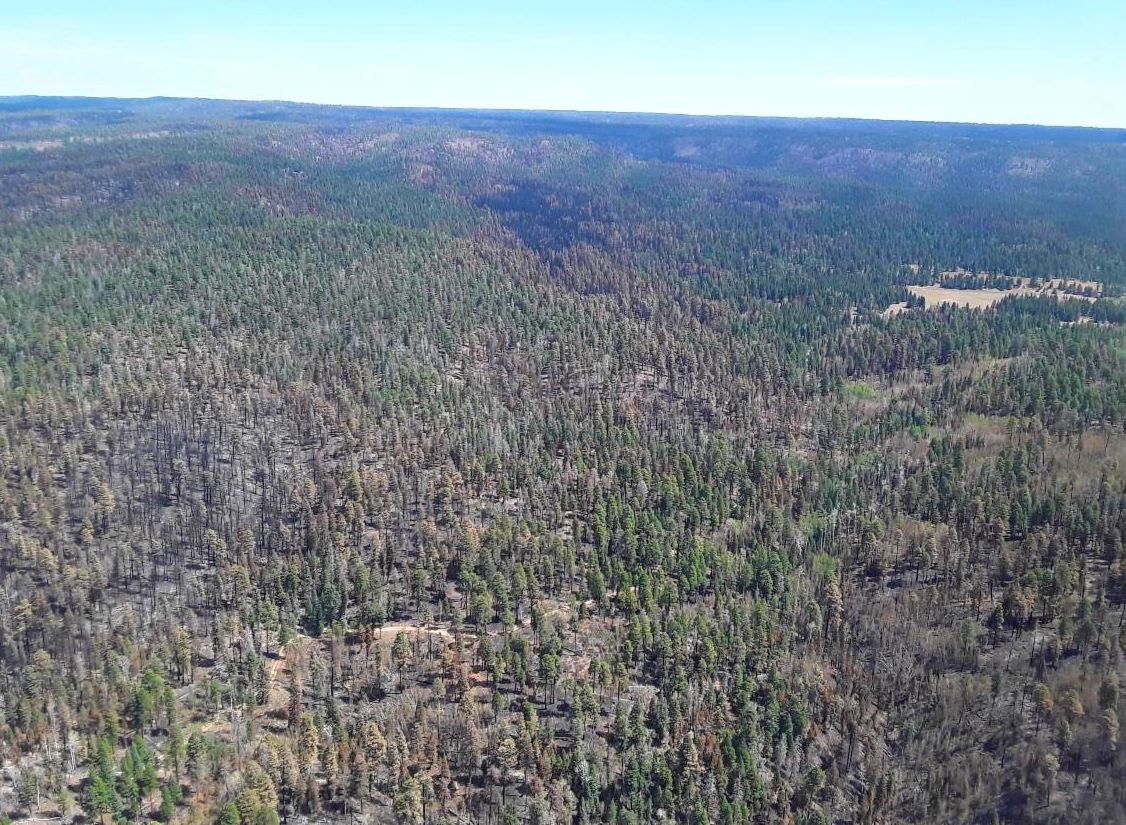
An aerial photo over the North Rim on August 20, 2025 (DOI BAER Team Photo)
GRAND CANYON, Ariz. – A multi-agency Department of the Interior (DOI) Burned Area Emergency Response (BAER) Team is beginning work this week to assess the impacts of the Dragon Bravo Fire on National Park Service and Bureau of Land Management lands. This process involves identifying the values at risk, determining any post-fire impacts to those values, and prescribing treatments to mitigate impacts.
The DOI BAER Team began work on August 21, and will identify imminent threats to life and property, followed by critical natural and cultural resources. Comprised of experts from multiple disciplines, the team includes hydrologists, botanists, wildlife biologists, recreation specialists, foresters, and cultural resource specialists from the US Fish and Wildlife Service, Bureau of Land Management, Bureau of Indian Affairs, National Park Service, and US Forest Service.
“The BAER assessment is the first step towards recovery on the North Rim of Grand Canyon,” said Ed Keable, Superintendent of Grand Canyon National Park. “By evaluating risks and identifying treatments now, we are laying the foundation for long-term landscape resilience. This careful, science-based work is essential to ensuring that areas can reopen safely.”
The team is committed to a collaborative approach that honors a legacy of stewardship and resource protection. During the Thursday afternoon in-brief, a local Tribal member reflected, “Throughout history, fire played a big part on these lands [it] is the beginning of something new.” By working closely with Tribes, land management agencies, and other stakeholders, post-fire recovery actions reflect cultural values, protect resources, and support ecosystem resilience.
An Inciweb page has been established to provide updates on the DOI BAER team’s efforts at Grand Canyon National Park and on BLM Arizona Strip Field Office lands. This page will include updates on the team’s field work, conditions found during their assessment, and proposed treatments.
A concurrent US Forest Service BAER effort is also underway for parts of the Kaibab National Forest affected by the Dragon Bravo Fire. More information on USFS BAER efforts can be found on Inciweb
— Grand Canyon National Park, in northern Arizona, encompasses 278 miles (447 km) of the Colorado River and adjacent uplands. Located on the ancestral homeland of 11 Associated Tribes, Grand Canyon is one of the most spectacular examples of erosion anywhere in the world—unmatched in the incomparable vistas it offers visitors on the rim. Grand Canyon National Park is a World Heritage Site. The National Park Service cares for the special places saved by the American people so that all may experience our heritage.