
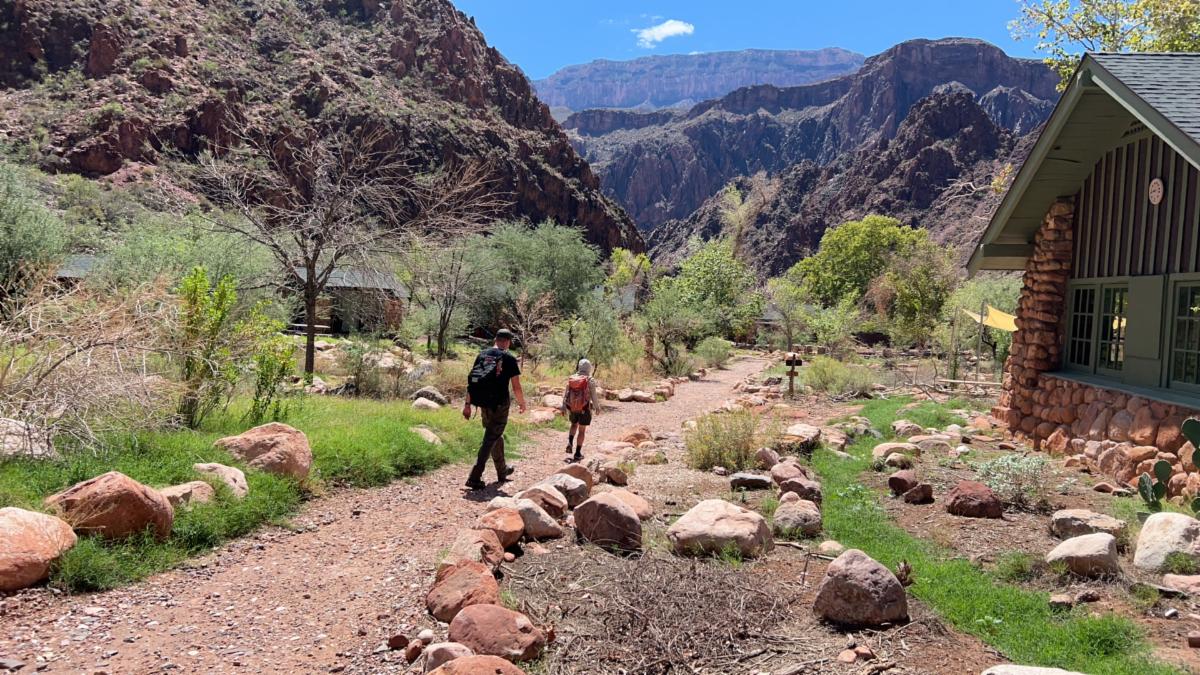
Members of the Incident Management Team hike through Phantom Ranch on Sep. 5 (NPS courtesy photo)
GRAND CANYON, Ariz. — Grand Canyon National Park continues response and recovery operations following the significant August 29 flash flood in Bright Angel Canyon and the Phantom Ranch area. Search operations remain active, while crews continue infrastructure assessments, stabilization work and efforts to restore a reliable water supply to the South Rim.
The park now has a path forward to restore water service and, based on current progress, expects that work to take weeks, not months.
Crews are moving forward with construction of a temporary water intake at Bright Angel Creek to replace the intake destroyed by the flood. Engineers are in the canyon designing the temporary intake, the existing Transcanyon Waterline contract has been modified to support the work, and construction activities are beginning this week.
The temporary intake is being designed to pump approximately 500 gallons per minute, the same capacity available before the flood. Once operational, it will allow water to move through the new Transcanyon Waterline system and begin replenishing South Rim storage while work on a permanent intake continues.
The August 29 flood caused extensive damage to the legacy Transcanyon Waterline, including approximately 40% of the old pipeline between the Phantom Ranch area and the North Rim. The Bright Angel Creek and Roaring Springs intake areas also sustained significant damage.
Importantly, the new pipeline infrastructure on the south side of the canyon was not damaged by the flood. Prior to the flood, the park was just over a month away from beginning operation of the new system. The park is now accelerating work that was already underway to bring that infrastructure into service.
Electrical service necessary to support work on the temporary intake system has been restored, debris removal is underway, and crews continue preparing the site for construction.
Testing and commissioning work is being accelerated at the new South Rim water treatment plant. The National Park Service is working closely with the Arizona Department of Environmental Quality to meet applicable requirements and bring the plant online safely and as quickly as possible.
While repairs move forward, water conservation remains critical.
The South Rim continues to rely on stored water. During the latest operational period, stored water declined approximately 0.37 feet, compared with approximately 0.7 feet per day under normal operating conditions.
Current conservation measures are offsetting approximately 137,000 gallons of potable water use each day, extending the amount of time available for crews to complete critical work on the water system.
The park is asking residents, employees, visitors, businesses and partners to continue conserving. Every gallon saved gives crews additional time and flexibility to complete the temporary intake and restore the system.
Teams are also actively monitoring the distribution system for leaks and unusual water use. Some leaks can be addressed immediately, while others require a more careful calculation. Certain repairs require the affected portion of the water system to be flushed before it can safely return to service. In some cases, flushing would consume more water than the leak is currently losing. Crews are evaluating each situation individually to determine which action will conserve the greatest amount of water overall.
To further reduce demand on the South Rim system, potable-water tanks, bottled drinking water, handwashing stations, portable showers, laundry facilities and portable toilets are being deployed throughout the community. Five 2,500-gallon potable-water tanks have already been placed, with additional tanks planned. More than 13,500 gallons of potable drinking water has also been staged throughout the South Rim.
The park is also evaluating responsible options for supplementing the water supply. Any water introduced into the existing system must meet specific water-quality and chemical compatibility requirements to avoid damaging the distribution and treatment systems. The National Park Service is working with the Arizona Department of Environmental Quality, contractors and potential suppliers to evaluate those options.
South Rim tap water remains safe to use, and there is no boil-water advisory in effect.
Grand Canyon National Park remains open on both the South Rim and North Rim. Visitors should expect modified operations and closures in affected inner-canyon areas and should check current park conditions before traveling. Visitors to the South Rim are encouraged to arrive prepared with drinking water and to conserve water throughout their visit.
Search operations also remain active following the August 29 flood. One person remains missing and unaccounted for. Search teams continue working in the delta area near Phantom Ranch, while river patrol crews are searching downstream along the Colorado River and adjacent areas where flood debris may have been carried.
The National Park Service and its partners remain committed to the search while response, repair and longer-term recovery work continues throughout the affected area.
Grand Canyon National Park will continue providing updates as work progresses.
— Grand Canyon National Park, in northern Arizona, encompasses 278 miles (447 km) of the Colorado River and adjacent uplands. Located on the ancestral homeland of 11 Associated Tribes, Grand Canyon is one of the most spectacular examples of erosion anywhere in the world—unmatched in the incomparable vistas it offers visitors on the rim. Grand Canyon National Park is a World Heritage Site. The National Park Service cares for the special places saved by the American people so that all may experience our heritage.